There’s a conversation happening in every small business owner’s head right now: “Should I use AI to write my blog content?” The answer is yes, but probably not the way you think. If you’re using AI to crank out generic articles that could have come from anyone, you’re actually hurting your site. Google’s E-E-A-T framework – Experience, Expertise, Authoritativeness, and Trustworthiness – rewards content that comes from a real person with real opinions. AI can’t fake that. But it can help you get your real opinions published faster and more consistently.
What E-E-A-T Actually Means for Small Businesses
E-E-A-T stands for Experience, Expertise, Authoritativeness, and Trustworthiness. It’s not a ranking score you can check somewhere – it’s a set of guidelines Google’s quality raters use to evaluate content. In practical terms, it means Google is trying to figure out: does the person writing this actually know what they’re talking about?
For a small business, this is good news. You do know what you’re talking about. You’ve spent years in your trade. The problem isn’t a lack of expertise – it’s finding time to sit down and write about it in a way that’s useful to people searching for answers.
That’s where the “Experience” in E-E-A-T matters most. Google added that first E specifically to reward first-hand knowledge. A photographer who explains their actual editing process beats a content farm rewriting the same “top 10 Lightroom tips” list every time. A carpenter who describes how they actually frame a wall beats a generic article about framing.
The Problem with “Just Let AI Write It”
Here’s what happens when you ask AI to write a blog post about your industry. It reads the internet, averages out what everyone else has said, and hands you a summary. It’s not new and the information is already indexed and being served by Google. It adds no value to the conversation – like a boardroom full of executives repeating each other around a table.
That kind of content worked five years ago when Google was mostly matching keywords. It doesn’t work now. Google’s systems are specifically designed to detect and deprioritize content that doesn’t add something to the conversation. If your article about photography lighting says the same things as the top 10 results already ranking, why would Google show yours?
Here’s the thing – Google isn’t anti-AI. Their official guidance on AI content says they focus on the quality of content, not how it’s produced. What they are against is low-value content at scale – and right now, a lot of AI-generated content falls into that bucket. When every article on your site reads like it was written by a different person (because it was written by a language model with no consistent voice), you lose the authoritativeness that comes from being a recognizable expert. Readers can feel it.
AI as a Power Tool, Not the Carpenter
I think about AI the way I think about a table saw. A table saw doesn’t design furniture. It doesn’t know whether you need a bookshelf or a dining table. But once you know what you’re building, it makes every cut faster and more precise than doing it by hand.
That’s how I use AI in my content workflow. I bring the experience, the opinions, and the editorial direction. The AI handles the parts that are genuinely tedious – structuring HTML, generating schema markup, checking for consistency, building interlinks between posts. The stuff that eats time without adding voice.
The key distinction: I’m not asking AI to have opinions for me. I’m asking it to help me publish my opinions efficiently. Every draft starts with my outline, my takes, my experience. The AI organizes it, flags gaps, and asks me questions I might not have thought of. But I’m reviewing every sentence before it goes live.
AI as a Megaphone for People Who Build Things
Here’s something that doesn’t get talked about enough: some of the most knowledgeable people in their field are terrible writers. Not because they’re not smart – because they’ve spent their careers doing the work instead of writing about it. The plumber who’s been at it for 25 years knows more about water pressure than anyone publishing articles about it, but sitting down to write 1,000 words about it? That’s not their trade.
AI changes that equation. It doesn’t replace your expertise – it translates it. You bring the knowledge, the stories, the opinions earned from years on the job. AI helps structure that into something readable and findable. It’s the difference between having something to say and being able to say it in a way that reaches people.
And that’s exactly the kind of content Google wants to surface. First-hand experience from actual practitioners, not polished prose from professional content writers who’ve never held the tools.
How the Workflow Actually Works
Let me walk you through the actual process, because the details matter here.
I start with a rough idea – sometimes just bullet points, sometimes a deep dive into something my clients have been asking about. I feed that to Claude Code, and it produces a first draft with annotation comments baked in. These are questions for me: “Should we add a section about X?” or “Worth mentioning Y here?” They’re decision points, not filler. I answer them in one pass, and the second draft applies my feedback.
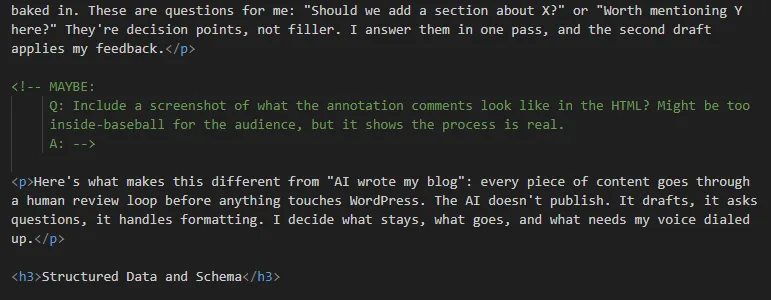
Here’s what makes this different from “AI wrote my blog”: every piece of content goes through a human review loop before anything touches WordPress. The AI doesn’t publish. It drafts, it asks questions, it handles formatting. I decide what stays, what goes, and what needs my voice dialed up or the tone adjusted.
Structured Data and Schema
Every post automatically gets structured data – that’s the behind-the-scenes code that tells Google exactly what your content is. Blog post schema, FAQ schema when the post answers common questions, how-to schema for step-by-step guides. Most small business blogs skip this entirely because it’s tedious to write by hand. With Claude Code, it’s automatic.
Why does this matter for E-E-A-T? Structured data doesn’t directly boost rankings, but it helps Google understand your content accurately. When Google can parse that your post is a how-to guide written by a specific author at a specific business, it has more signals to work with when evaluating expertise and authoritativeness.
Interlinking – The Authority Builder
This is where the workflow really pays off for E-E-A-T. Every time I write a new post, Claude Code checks all my existing content for interlinking opportunities – both directions. New posts link to relevant older ones, and older posts get flagged for links to the new content.
Why does interlinking matter so much? It builds what SEO people call “topical authority.” When your photography blog has a post about your Lightroom editing workflow that links to your post about color consistency, which links to your post about brand photography – Google starts to see you as someone who covers this topic thoroughly. You’re not just a one-off article. You’re an authority with depth.
Doing this manually is brutal. You’d have to remember every post you’ve ever written and scan each one for linking opportunities every time you publish something new. Claude Code maintains an index of all posts – titles, tags, section headings – and surfaces connections I’d miss. It’s like having a librarian who’s read everything you’ve ever written and can cross-reference instantly.
What This Means for Your Content Strategy
You don’t need this exact workflow to build E-E-A-T. But you do need the principles behind it:
- Start with your experience. AI can’t invent your years on the job. Feed it your knowledge, not the other way around.
- Keep a consistent voice. Your blog should sound like you, not like a different writer every week. Use AI to maintain that voice at scale, not to replace it.
- Build depth, not volume. Ten thoughtful posts that interlink and cover a topic from multiple angles beat fifty generic ones that say nothing new.
- Handle the technical SEO. Schema markup, proper HTML structure, meta descriptions, alt text on images – these are exactly the kinds of tedious-but-important tasks AI handles well.
- Stay in the editor’s chair. Review everything. Have opinions. Disagree with the AI’s suggestions when your gut says otherwise. That’s the “Experience” in E-E-A-T, and no algorithm can replicate it.
Your Expertise Deserves to Be Found
Google isn’t penalizing AI-assisted content. They’re penalizing low-value content – and a lot of AI-generated content happens to be low-value because people are using it to skip the part that actually matters: their own expertise.
Use AI the way you’d use any good tool. Let it handle the repetitive work so you can focus on the part only you can do – sharing what you’ve learned from years of actually doing the work. That’s what builds E-E-A-T. That’s what ranks. And honestly, that’s what your readers came for in the first place.
If you’re a small business owner trying to figure out how to show up in search without spending all day writing, let’s talk about it. Building authority online doesn’t have to mean becoming a full-time blogger – it just means being smart about how you share what you already know.